
If you’ve been hesitant to apply for a small-business credit card because you’re unsure where to start or if you’re even eligible, you might find the process is a lot less intimidating than it seems.
American Express offers a large portfolio of business cards, so you’re bound to find something that fits your business needs. In this guide, we’ll break down the American Express business card requirements to help you answer some of the confusing application questions.
Related: Business credit cards: What they are and how they work
Who can apply for an Amex business card?
You don’t need to own a traditional business with employees or a storefront to qualify for an Amex business card. Sole proprietors, freelancers and people earning money from a side hustle can also be eligible to apply.
That could include everything from driving for Uber or Lyft to selling items online. And you don’t necessarily need to have formed an LLC or registered a separate business entity.
Applying as a sole proprietor or freelancer
If you run your business by yourself and haven’t established a separate business entity, you’ll generally apply as a sole proprietor. In that case, you can typically use your own name as your legal business name, your home address as your business address and your Social Security number as your federal tax ID.
For example, Toni is a freelancer and uses her own name as her legal business name on card applications. If you’ve registered a business name or established a legal business structure, such as an LLC, you’ll provide that information instead.
Related: What credit score do you need for business credit cards?
Which Amex business card is best for you?
American Express offers a variety of business cards, so the best fit will depend on the type of rewards and benefits you’re looking for.
Reward your inbox with the TPG Daily newsletter
Join over 700,000 readers for breaking news, in-depth guides and exclusive deals from TPG’s experts
Amex’s Membership Rewards-earning cards can be a good fit if you value flexible transferable rewards, while its cobranded cards make more sense if you’re loyal to a specific airline or hotel program.
For example, the Hilton Honors American Express Business Card includes automatic Hilton Honors Gold status.
Amex business card application requirements
Amex business card applications require information about both you and your business, including your business structure, annual revenue and estimated monthly spending. You’ll also need to provide identifying information, such as your Social Security number or federal tax ID.
Amex application and welcome offer restrictions
Qualifying as a business owner doesn’t mean you’ll automatically be approved for every Amex business card or eligible for every welcome offer. American Express has several application restrictions you should know before applying.
For starters, Amex generally limits cardmembers to five traditional credit cards at a time, although cards without a preset spending limit typically don’t count toward that limit. Amex may also restrict how many cards you can be approved for within a certain period.
There’s also Amex’s once-per-lifetime rule, which states that you won’t be eligible to earn a welcome offer on a specific Amex card if you’ve had that card before. However, Amex sometimes targets cardmembers for offers that don’t include this restriction, so it’s worth checking the terms of your specific offer before applying.
One nice thing about applying for an Amex business card is that you can typically find out if you’re approved without affecting your personal credit score. If you’re approved and choose to accept the card, however, your personal credit score will be affected.
Another potential advantage of Amex business cards is that they generally don’t appear on your personal credit report, so opening one typically won’t add to your Chase 5/24 count.
Related: What credit score do you need for business credit cards?
How to apply for an Amex business card
If you already have an Amex card, you can sign in to your account to shorten the application process.
But if you’re new to Amex, the first page of your business card application will look like this (note that your welcome offer may vary as not everyone is targeted for the same offer):
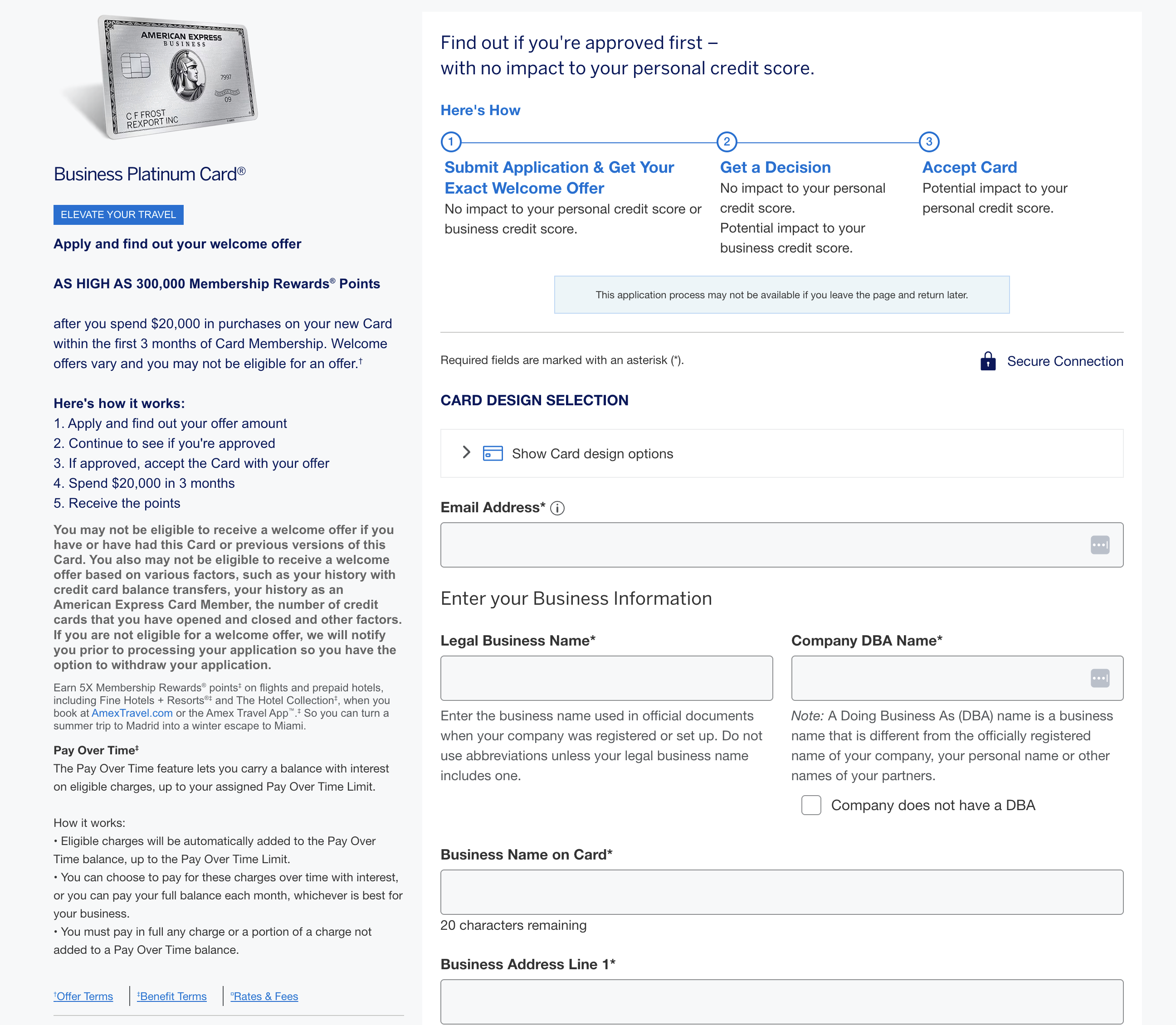
Applying for an Amex small-business card is similar to applying for a personal Amex card, but you’ll need to provide some additional information about your business.
Enter your business information
The basic information, like your email address, is straightforward, so let’s look at the boxes that can be tricky:
- Legal business name: If you’re a sole proprietor without a separately registered business name, you can generally use your own name as the legal business name. If you’ve registered a business name or established a legal structure for your business, enter the name associated with that business.
- Business name on card: This is the business name that will appear on your card below the cardmember’s name. You can use your legal business name here, provided it fits.
- Company DBA name: DBA stands for “doing business as.” Enter your registered DBA here if you operate under a name that’s different from your legal business name.
- Business address: This can be the same as your home address if you run your business from home.
- Business phone number: Enter the primary business phone number you’ll use for verification.
- Industry type: Select the industry that most closely corresponds with your business operations. Options include agriculture, construction, nonprofit and retail trade, among others. You can also select “other.”
- Company structure: Select the legal structure that applies to your business, such as sole proprietorship, partnership or corporation.
- Number of employees: Amex requires you to enter at least one employee. If you’re a sole proprietor with no other employees, enter one for yourself.
- Gross annual business revenue: Enter the amount your business earns annually before taxes and expenses. If you’re just starting a business and haven’t generated revenue yet, you may be able to enter zero.
- Estimated monthly spend: Enter the amount you anticipate charging to the card each month.
- Federal tax ID: Sole proprietors without an employer identification number may generally use their Social Security number.
- Role in company: Select the option that most accurately describes your role in the business.
Enter your personal information
After filling out your business information, you’ll scroll down to enter your personal information.
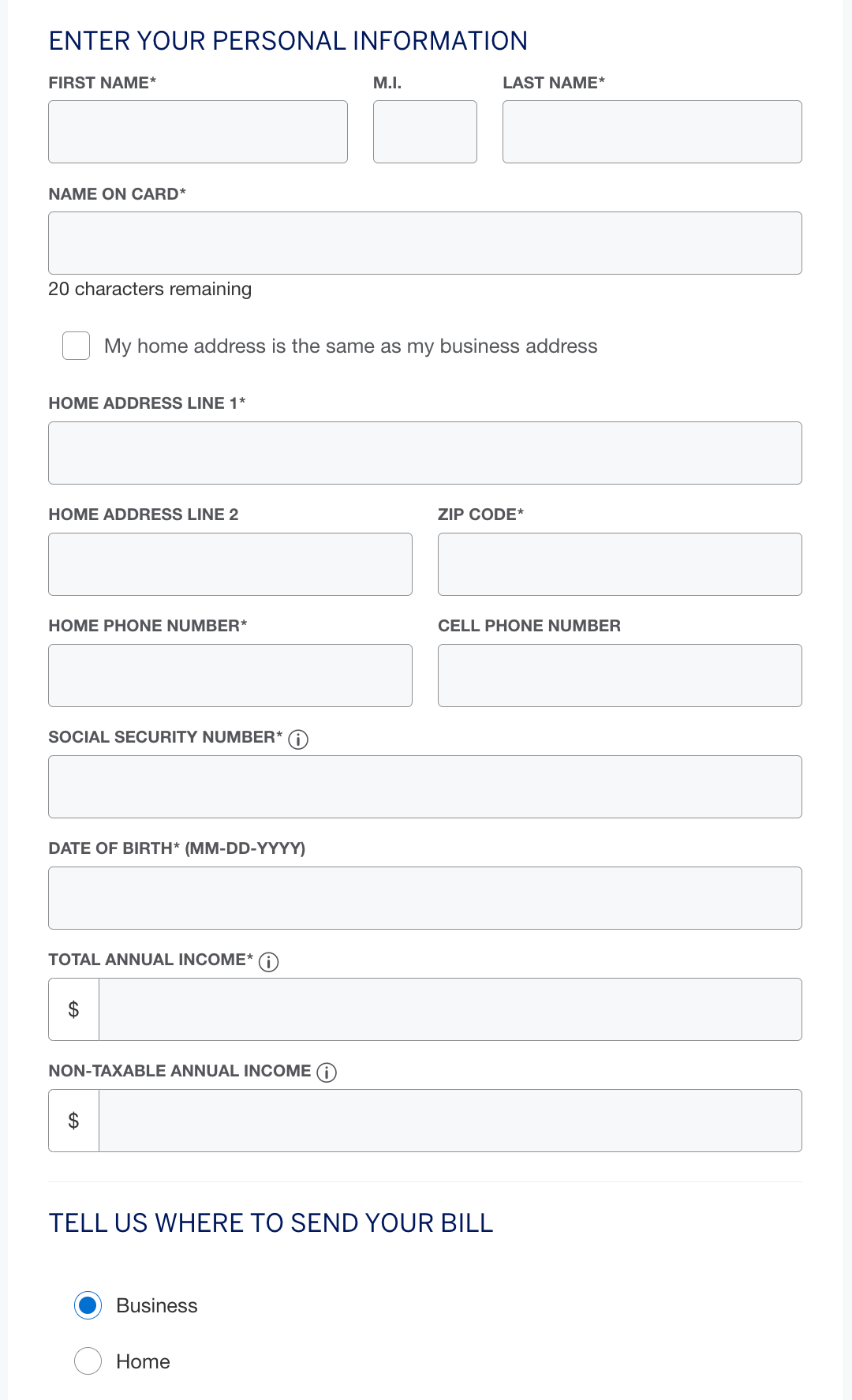
Most of the questions here are also fairly painless, but pay particular attention to the “TOTAL ANNUAL INCOME” box. Include all eligible income you can reasonably expect to use to pay your bills. This can include your own income, income from a spouse or partner you have access to and profits you’ve taken from your business.
The “NON-TAXABLE ANNUAL INCOME” box is optional and can be left blank. Still, if you receive any income exempt from federal income tax (Social Security, child support, disability benefits, etc.), you can enter that annual total.
Related: How to apply for a credit card
Review and submit your application
The final step is selecting the address (home or business) where you’d like American Express to send your bill and reviewing the terms and conditions.

At this point, you can save the application and apply later, or submit it for review.
What happens after you submit your application?
After you submit your application, you may receive a decision in under a minute. If you’re approved, you’ll have the opportunity to accept the card and your welcome offer.
If Amex can’t make an immediate decision, your application will go into pending status while the issuer reviews your information.
What if your application is pending?
A pending application doesn’t necessarily mean you’ve been denied. It may simply mean Amex needs more time to review your application or verify some of the information you provided.
If Amex asks for additional documentation, make sure to follow the instructions it provides. You may need to verify details about yourself or your business.
What to do if your Amex business card application is denied
If your card application is denied, review the reason Amex provides before deciding what to do next. In some cases, the issue may involve information on your application that needs to be verified or updated.
You can also contact American Express to ask whether your application can be reconsidered. Be prepared to answer questions about your business, income or other information included on your application.
Related: Your guide to calling a credit card reconsideration line
Bottom line
Applying for your first business card can feel intimidating, especially if your business is a freelance gig or side hustle rather than a traditional company. But the Amex application itself isn’t much more complicated than applying for a personal card.
Just be prepared to provide information about both yourself and your business, including your business structure, revenue and estimated monthly spending. With the right information in hand, applying for an American Express business card can be a relatively straightforward way to add another rewards card to your wallet.
For rates and fees of the Amex Blue Business Plus, click here.
Related: The ultimate guide to credit card application restrictions

